Home / First trade / Your first deposit
Your first deposit: who you are really trading with
The platform escrows the coins, not the money. The cash moves from one real person's bank account to another — and that single fact decides which side of the trade carries the risk.
Peer-to-peer trading is the platform matching you with another real person and holding the crypto in escrow while the two of you settle in cash. The platform escrows the coins, not the money — the money moves from their bank account to yours. Understand that one sentence and you know where the risk sits: the coins are rarely the problem; the money can be.
How it works
Buying USDT, a full cycle looks like this:
- You place the orderPick a seller on the P2P page, enter the amount, confirm.
- The platform locks their coinsThe important part — the seller's USDT is now held in escrow and they cannot back out.
- You pay using the details on the orderTransfer to the account shown, and check the recipient's name.
- You mark the order as paidDo not skip this. The seller is only notified once you do.
- The seller confirms and the platform releasesThe coins land in your funding account.
Usually a few minutes end to end. If the seller stalls on release you can raise a dispute inside the order and the platform steps in — which is exactly why you never settle outside the platform. Off-platform means no escrow, no dispute process, and no record.
Choosing a counterparty
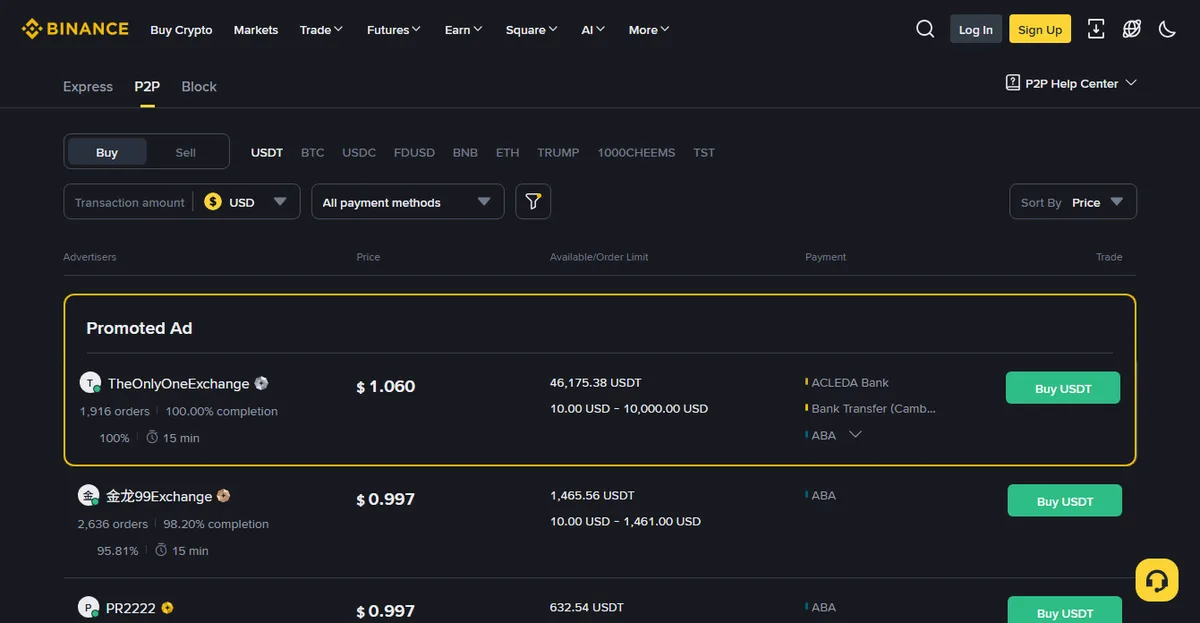
Each seller has a few numbers beside them. These are the ones worth reading:
| Metric | What to look for |
|---|---|
| Completed orders | A large number means this account has been doing it for a long time |
| Completion rate | Below a certain level means frequent cancellations and wasted time |
| Average release time | Shorter is better; it saves you waiting after you have already paid |
| Account age and verification tier | New accounts and low tiers carry more risk |
| Payment methods supported | Pick one you can actually use, rather than discovering that after ordering |
Price is usually not the deciding factor. Quotes at a given moment barely differ, and choosing a counterparty with poor metrics to save a fraction is a bad trade.
Six rules that save a lot of trouble
- Payer and payee must both be you and themYour own account, paying the person named on the order. If the names do not match, cancel and dispute rather than saving time.
- Never accept third-party paymentEspecially when selling: if the person paying you is not the counterparty on the order, you cannot verify where that money came from.
- Leave the transfer reference blank or neutralNothing crypto-related. Not to conceal anything — some banks' risk models react to those words and trigger avoidable review.
- Never move the conversation off-platformRequests to chat on another app, to pay directly, or claims that platform fees are high all exist to pull you outside the protection.
- Always mark the order as paidWithout it the seller does not know, the order times out and cancels, and you have to dispute to get your money back.
- Keep the full recordOrder screenshots, payment receipts, in-platform chat, for at least six months.
In peer-to-peer trading the money you receive comes from another individual. If those funds turn out to be connected to a case elsewhere, your bank account can be frozen and you can be asked to prove source of funds, even with no knowledge and no fault. The mechanism and the defence are in the frozen accounts piece. This touches law that varies by country — follow your local rules and take professional advice.
Common traps
Fake payment receipts
Selling USDT, the buyer sends a screenshot showing a completed transfer and presses you to release. Screenshots can be fabricated, and genuine ones can be reversed. Being rushed into releasing first is a signal the US Federal Trade Commission flags on its consumer page about crypto scams as well (checked 2026-09). The only thing you can rely on is money actually arriving in your bank account — not a screenshot, not an SMS alert.
Slightly short
The amount received is a little less than the order, with "I'll send the rest shortly". Do not release. A mismatch goes straight to dispute, and the platform handles it against the order amount.
"I overpaid, send some back"
They claim to have sent too much and ask you to refund part of it to a different account. This is a standard laundering move: the surplus may have come from elsewhere, and the refund becomes a transfer you initiated. Decline, and tell them to raise a dispute.
Requests to trade outside the platform for a better price
Usually justified by limits or a better rate. Outside the platform there is no protection at all, and whatever happens is yours.
Selling: the risk runs the other way
Buying and selling mirror each other procedurally and invert entirely in terms of risk.
When buying, you pay first, so the risk is paying and not receiving — and that risk is covered by escrow, because the coins were locked before you paid. Buying is comparatively safe.
When selling, you hand over the coins first (into escrow) and wait for money. The risk is that the money itself is a problem: a fabricated receipt, or a real payment from tainted funds. The platform cannot help with that side, because the money never passes through it.
Hard rules when selling
- Only trust money visible in your own bank account — not screenshots, not notifications, not assurances. Open your banking app and look.
- The payer's name must match the order — no exceptions.
- The amount must match exactly — not a cent short.
- Do not hurry to release — the more they push, the slower you go. A genuine buyer does not mind an extra minute of checking.
- Refuse every refund request — send them to the dispute process; do not transfer anything out yourself.
The first and last correspond directly to the mechanism described in the frozen accounts piece, and the two are worth reading together.
Which payment method to choose
Sellers support different methods, and the choice affects more than convenience.
The general principle: pick something that leaves a clean record and is in your own name. A clean record matters enormously if you ever have to document source of funds, and the name requirement is not negotiable — you cannot use a family member's account.
Different channels also have different speeds and limits, which affects which sellers you can match with. For a first attempt, use something you already use daily rather than chasing a marginally better rate through an unfamiliar route.
Doing it for the first time
Run the first one with a very small amount, purely to learn the flow. A few tens of dollars is plenty — what you are verifying is that you know where to press, not how much you acquired.
Treat the first one as a rehearsal, not a purchase.
Once that works, move to a normal amount. Same logic as how much to put into the first trade: make the process certain before making the number larger.
Also pick a moment when you are not rushed. P2P orders have a payment deadline, and a timeout means cancellation and cleanup. Twenty uninterrupted minutes beats any technique.
And one more: work out how the money gets back out first. Buying is easy; converting back to local currency varies enormously by region. Before committing a meaningful amount, run one complete loop — buy, sell, withdraw to the bank — and confirm the route is open. Plenty of people skip this and only find the problem when they actually need the money.
The peer-to-peer flow, dispute handling and release rules were checked in 2026-08 against the Binance help centre. Platform rules and available payment methods differ by region and do change; anything on the bank side is governed by your own bank's current terms.