Home / Basics / The fee schedule explained
The Binance fee table, read column by column
The first look is confusing: a pile of tiers, two percentage columns, and an easily missed and-or. Ten minutes here and you can stop thinking about it.
People make one of two opposite mistakes with fees. Either they never look, and only notice months later that something has been quietly eating the balance; or they obsess over a fraction of a basis point and reorganise their whole approach around it. The aim here is that you spend ten minutes understanding the table and then stop thinking about it.
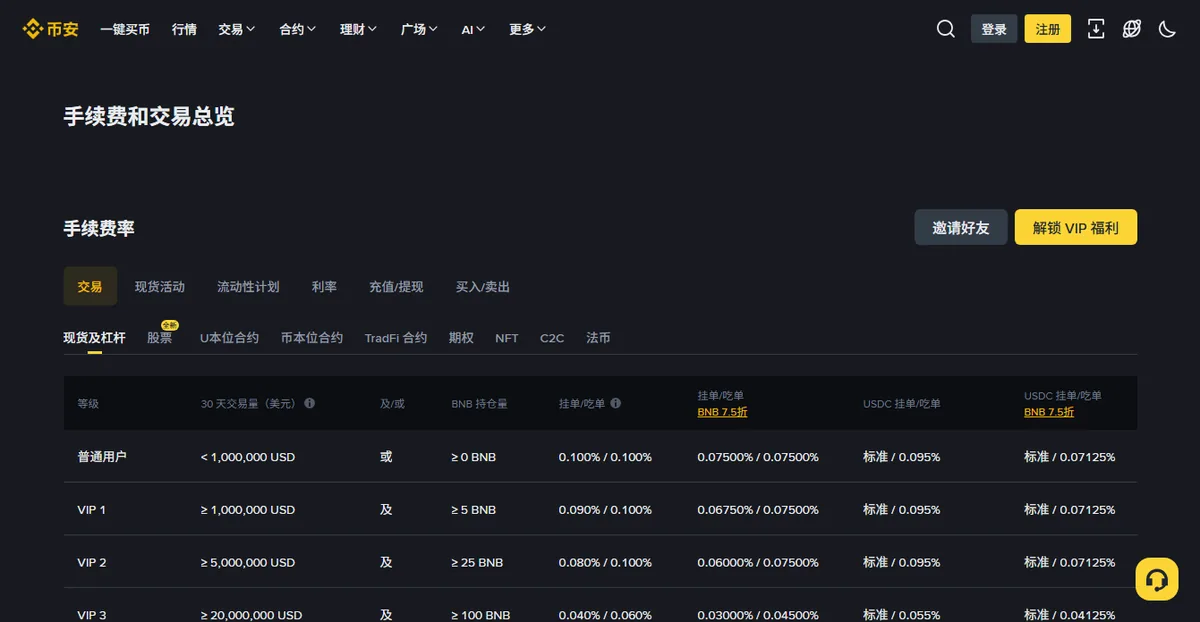
What each column is asking
The header row looks worse than it is. There are only four kinds of information in it: who you are, how much you traded, what you pay to provide liquidity, and what you pay to take it.
| Column | The question it answers |
|---|---|
| Level | Which tier you are in. A new account starts in the base tier; the VIP rows below need very large volume. |
| 30-day volume | What you have traded in the last thirty days, measured in dollars. Cross the threshold and you move up. |
| BNB holding | Some tiers require this as well. Watch the word "and" versus "or" — on some rows both conditions must hold. |
| Maker / taker | Two rates. Maker is when your order rests on the book; taker is when you consume someone else's. |
| The BNB-discount column | The rate that applies when fees are paid using BNB. The numbers there are lower than the column to its left. |
Find the base tier row first — that is yours. The VIP numbers look great and mean nothing to a new account.
How a rate becomes money
Fees are a percentage of the traded value, not a flat charge per trade. An easy mental example: if the taker rate is ten basis points and you trade a thousand dollars, the fee is one dollar. Double the size, double the fee.
Here is the part beginners miss: a round trip is charged twice. Once buying, once selling. So when you judge whether a trade is worth doing, count both legs rather than one.
The fee is normally taken from the asset you bought. Buy BTC, pay in BTC — which is why the quantity credited is slightly less than the quantity ordered. That is not a bug.
There is more than one table on that page
The page has several tabs beyond spot: deposits and withdrawals, promotions, interest rates, buy and sell. The one a beginner should glance at is deposits and withdrawals — on-chain network fees are an entirely separate thing from trading fees, and frequently far larger.
Is the maker-taker difference worth caring about
Yes, but not by calculating. By habit.
Get into the habit of using a limit order whenever a limit order will do, and the cheaper tier follows automatically — while you also avoid slippage. Those two together are worth much more than studying decimal places. When to use which is in what those order buttons mean.
Where the BNB discount and the referral reduction each apply
These are two different things, and it is easy to mix them up.
The BNB discount is a switch in account settings. Turn it on and the system pays your fees out of your BNB balance, and in exchange applies a lower rate. It acts on the rate itself — that lower column in the table is what it produces.
The reduction that comes with a referral code is a separate arrangement, part of the platform's referral programme: a proportion of the fees you generate comes back as a reduction, with the ceiling set by whatever the platform is running at the time. It does not conflict with using the BNB discount.
If you have not signed up yet, entering a referral code at registration means eligible new users can receive a trading-fee reduction; the proportion is whatever Binance's sign-up page shows at the time. That field appears during sign-up, and there is usually no way to add a code once the account exists.
The actual proportion is whatever the Binance page shows at the time and may change with policy. This site contains Binance referral links and we may earn a commission; signing up with the code does not cost you more (check the current page).
To check the current rates and programme terms, the official page beats any third-party summary: Binance fee schedule.
VIP tiers: when do they become reachable
That left-hand column running from VIP 1 upward looks like a progress bar, which makes it tempting to think a bit of effort gets you there.
Run the numbers and it clears up. The lowest VIP threshold is on the order of a million dollars of volume in thirty days. For someone starting with a few hundred or a few thousand, that is not "a bit of effort" — it is a different scale entirely.
Also mind the "and / or". Some rows require both the volume and the holding; others accept either. One word, large difference. Do not skim it.
So the conclusion is blunt: a beginner reading the fee table only needs the first row. Know the rest exists; do not study it.
Something more worth your attention: which asset pays the fee
There is a setting that decides where fees come from. With the BNB discount on, they come out of your BNB balance at a discount; off, they come out of whatever you are trading.
A knock-on effect people rarely consider: leaving it on means permanently holding some BNB, and BNB has its own price. You have taken on a small volatile position in order to save on fees. At small sizes it hardly matters, but the relationship is worth knowing about.
The things that cost more than fees
Possibly unwelcome, but true: on a small starting balance, trading fees are usually not the largest cost line.
- Slippage — a market order in a thin market can cost more in one trade than dozens of fee charges.
- Network fees — on-chain transfers cost money, and picking the wrong chain can cost more than several trades. On Ethereum this cost is called gas, and ethereum.org’s gas documentation explains what it is made of better than any exchange page (checked 2026-09).
- Trading frequency — every round trip is two charges. Frequency is the multiplier; the rate is only the multiplicand.
- The spread on conversion — the rate you get buying USDT with local currency usually differs from the mid-market rate, and it is easy to leave it out of your sums.
A concrete comparison
Two people each start with a thousand dollars for a year:
- The first buys and leaves it alone. Their fee cost is one purchase, effectively negligible.
- The second trades in and out once a week, so fifty-odd round trips. At the same rate they pay well over a hundred times what the first person paid — before counting slippage and spread.
This is not an argument that frequent trading is wrong. It is the observation that the rate is the multiplicand and the number of trades is the multiplier. To genuinely save money, reduce trades first and discuss rates second.
When does studying fees actually start to pay
Honestly, for most people reading this: not yet. Fees start to matter when your monthly volume is close to a tier threshold. Until then, attention spent on not buying the wrong thing, not sending to the wrong chain, and not getting scammed pays far better.
If you do not have an account yet
None of this column applies until an account exists. Opening one is not complicated, but two details are easy to trip over: where the referral field is, and which step identity verification stalls on.
Both of those, along with the full sign-up walkthrough, the verification requirements and the six common rejection reasons, are in the complete Binance sign-up guide. The sign-up link with our referral code lives on that page only. The code shown above is here so you can copy it into the form; this page carries no referral link of its own and just explains the fees.
What are Binance spot trading fees?
The maker and taker rates for the base tier are published on the official fee overview page, with a lower column applying when the BNB discount is switched on. Rates and thresholds change, so check the official page as it stands before you trade.
Do the referral reduction and the BNB discount stack?
They act at different levels: the BNB discount changes the rate itself, while the referral reduction returns a proportion of the fees you generate. How exactly they combine follows the platform's current programme terms.
Can I add a referral code after signing up?
Generally no. Entering the code is part of the registration flow and there is usually no way to add it once the account exists. If the reduction matters to you, watch for it during sign-up.
Tier thresholds, maker and taker rates and the BNB discount were checked in 2026-08 against the Binance fee schedule. Rates and promotional terms change often — read the official page as it stands before you trade.