Home / Basics / Exchange, wallet, chain
Exchange, wallet, chain: which one does what
These three get used interchangeably, but they decide the same question: who is actually holding your money. Blur them and you lose funds somewhere you assumed was safe.
English is a little kinder here than some languages, but "wallet" still does too much work. In one sentence it can mean your exchange account, an app on your phone, or a piece of paper in a drawer. This piece separates them — because when they blur together, money disappears from places you thought were safe.
| Exchange account | Self-custody wallet | The chain | |
|---|---|---|---|
| What it is | An account a company opened for you | A key you hold yourself | A public ledger |
| Who can move the funds | You, and that company | Whoever holds the key | Nobody — it only records |
| Forgot the password | Recoverable | Not recoverable, ever | Not applicable |
| Where transfers are recorded | Company database, mostly | On the chain, publicly | It is the record |
| Can it be frozen | Yes, compliance requires it | Nobody can freeze the wallet itself, but a stablecoin issuer can freeze its own token at a given address | No |
The exchange account: convenient, but you are not the custodian
Inside an exchange, your balance is a number in its database. It corresponds to real assets — a properly run venue segregates customer funds and publishes proof of reserves — but legally and technically, the company is holding them for you.
What you get in return is genuinely useful. Password resets. A dispute process. An interface built for people who have never done this. A purchase is a few taps. For someone starting out, none of that is trivial.
That convenience is real, and it is not free.
What you accept is two categories of risk: company-level (solvency, compliance, breaches) and account-level (password leaks, phishing). You can defend against most of the second yourself — see the three things to set up on day one.
Proof of reserves, and what it actually proves
Most major venues now publish proof of reserves. The mechanism is roughly: aggregate customer balances into a verifiable tree, publish the root, publish the holdings in the exchange's own on-chain wallets, and let third parties compare "what we owe" against "what we hold".
Useful, with limits worth stating. It shows there was no obvious shortfall at a moment in time. It does not show whether those assets are pledged elsewhere, what the liabilities look like, or what happens next. It is a health check, not an insurance policy. Having one beats not having one; treating it as a guarantee is a mistake.
Incidentally, you can usually verify your own record is in the tree — platforms that publish this usually put the entry in account settings. It is easy to never click it. The five minutes it takes will move your understanding from "I have heard of this" to "I have seen it work".
The self-custody wallet: your key, and your problem
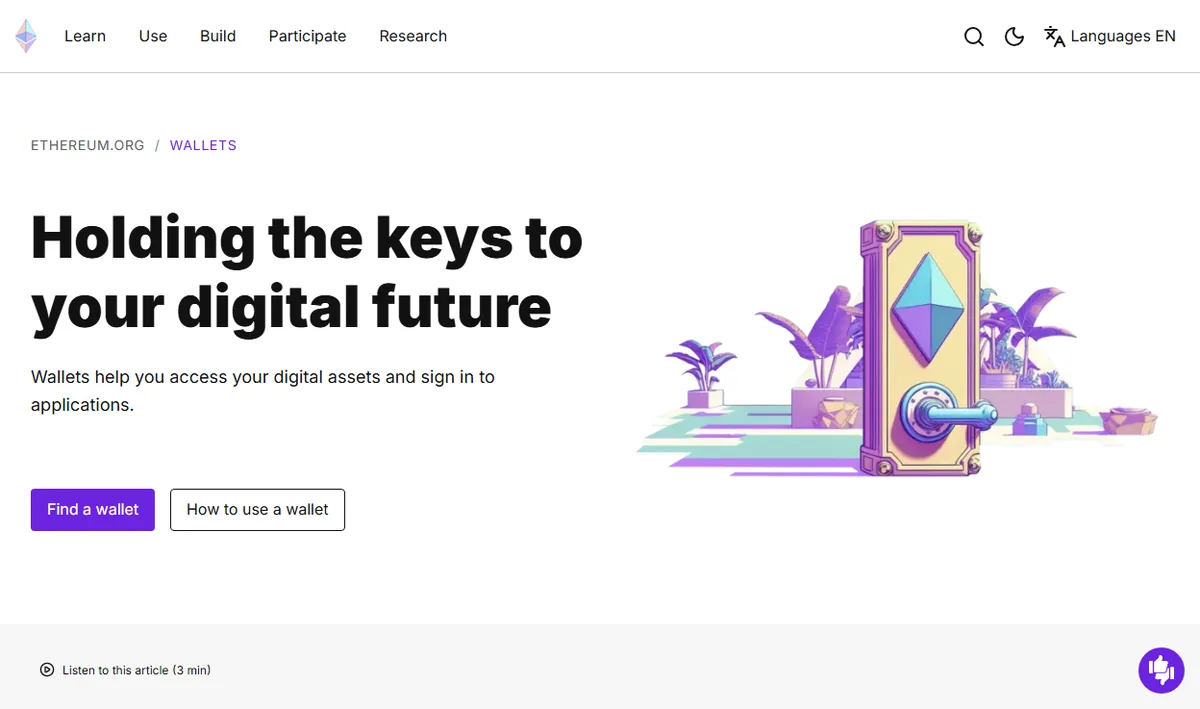
A self-custody wallet does not store coins. That sentence throws people the first time: there is nothing inside the wallet. The coins are recorded on the chain the whole time. The wallet holds a key proving that a given address belongs to you. That is not our phrasing — it is how ethereum.org defines a wallet, in a document maintained by the community rather than by any exchange (checked 2026-09).
That key normally arrives as a seed phrase — twelve or twenty-four ordinary English words in a fixed order. Whoever has those words has everything at that address. No second factor, no support desk, no appeals process.
So the safety of self-custody rests entirely on you: whether the words got photographed, saved into a cloud note, or typed into a page claiming to "verify" something. Each of those hands the words to someone else. Detail in why nobody gets your twelve words.
Hot and cold
You will meet these two words. The difference is one thing only: is the key connected to the internet. An app on your phone is hot and convenient. A device that never goes online is cold, less convenient, and out of reach of malware.
A workable split: day-to-day amounts on an exchange, because that is where you use them; anything genuinely long-term in cold storage. The middle option — a large balance in a phone wallet — strikes me as the worst of both, with neither the recovery path of an exchange nor the isolation of cold storage.
Your exchange app also has a "Wallet" tab. That is not this.
Here is where most of the confusion comes from. Open an exchange app, tap Wallet or Assets, and you see spot account, funding account, earn account and so on.
All of those are internal bookkeeping categories, not self-custody wallets. The money is still with the company; it has just been sorted into drawers. Moving between drawers is instant and free, because nothing touched a chain — which gives you a quick test: if a transfer is instant and costs nothing, it is internal bookkeeping.
A real self-custody wallet is a separate app or device, and the first time you open it, it makes you write down a list of words. If something never asked you to write down words, it is not a self-custody wallet.
Addresses and chains: why the same string is not recognised elsewhere
A receiving address is a string of characters. Different chains use different formats — a Bitcoin address and an Ethereum address are visibly different. Ethereum’s own developer documentation is blunt about it: the same protocol rules can run several independent networks, and mainnet and each testnet keep separate books (ethereum.org on networks, checked 2026-09).
The trouble is with the ones that look identical. Ethereum, BSC, Arbitrum and similar chains share an address format, so one string is valid on all three — but they are three separate ledgers. Send USDT to an address on the wrong chain and the funds do arrive at that address, just in a different book. Whether you get them back depends on who holds the key and whether they will help. If the recipient was an exchange deposit address, the usual answer is that you do not.
How to avoid it is in picking the right network, including a fixed checking sequence.
One: which chain is this address on? Two: does the recipient support that chain? Three: on that chain, is this the right version of the asset (some venues list more than one)? Asking those three takes less time than writing a support ticket afterwards.
How each of the three fails
Rather than memorising pros and cons, memorise failure modes. When something goes wrong, you need to know who to talk to.
| What happened | Exchange account | Self-custody wallet |
|---|---|---|
| Forgot the password | Recovery flow, usually fine | Fine if you have the seed phrase; over if you do not |
| Lost the phone | Log in elsewhere, re-verify | Fine if you have the seed phrase — restore on a new device |
| Someone saw the seed phrase | Not applicable | Move everything to a new wallet immediately; a minute matters |
| Sent to the wrong address | A slim chance if the recipient uses the same venue | Essentially nothing to be done |
| The platform fails | You are a creditor; outcome depends on the wind-down | Entirely unaffected |
| Account restricted by risk controls | Appeal via the platform, expect to prove source of funds | No platform account to restrict — though an issuer-controlled stablecoin such as USDT can still be frozen at your address |
Look at that table and one thing stands out: the two columns barely overlap. Which means "which is safer" is the wrong question. The right one is: which kind of mistake am I more likely to make?
What a beginner should actually do
Short answer: use an exchange account only, and postpone self-custody.
Not because self-custody is bad, but because of the order of the learning curve. You are already learning to read a market, to spot scams, and to manage a seed phrase. Three at once is a lot of surface area for error, and the seed phrase one is the error you cannot undo. Once you are comfortable on the exchange and actually holding something you do not intend to move, spend a weekend learning self-custody properly. By then you will know what you are defending against.
And one thing that is easy to skip: work out how money gets back out before you work out how it gets in. Open an account first and you may only then discover how narrow the exit is where you live. Thinking about it first saves a lot of grief.
Can I skip exchanges entirely and only use a wallet?
Technically yes, practically awkward. The problem is the entrance: you hold local currency, and a wallet only holds on-chain assets. Converting one to the other requires something that can accept local currency, and exchanges are the mainstream version of that. Alternatives exist, but with higher barriers, worse rates and less to verify.
A more realistic arrangement: the exchange is the door, the wallet is the storeroom. In and out through the door; storage as you prefer.
When is it time to learn self-custody?
No fixed answer, but two workable signals.
The first is size: when the balance on the exchange has reached the point where losing it tomorrow would genuinely upset you, move some of it out. The number differs for everyone; what matters is your own line.
The second is purpose: if you start wanting to do things on-chain — a protocol, an airdrop, an application that only connects to a wallet — you will need one eventually. The right move then is to create an empty wallet and run a few dollars through it in both directions until every step is familiar, and only then put anything meaningful in.
Do not skip that rehearsal. Every on-chain click is irreversible, and rehearsing costs almost nothing.
Three sentences
- The chain is a public ledger. It does not know people, only addresses and keys.
- An exchange is a company that custodies and matches trades for you. Convenient, recoverable, but you handed over custody.
- A self-custody wallet is a key you hold. No platform can freeze the wallet (issuers of tokens like USDT can still freeze their own token at an address), and nobody can recover it for you.
The next two lessons cover the asset you will meet first (what USDT is) and the screen you will see first (what those order buttons mean). If avoiding scams is the more urgent concern, jump to the playbooks piece.